
Top Link Building Strategies for Every Business
October 28, 2026
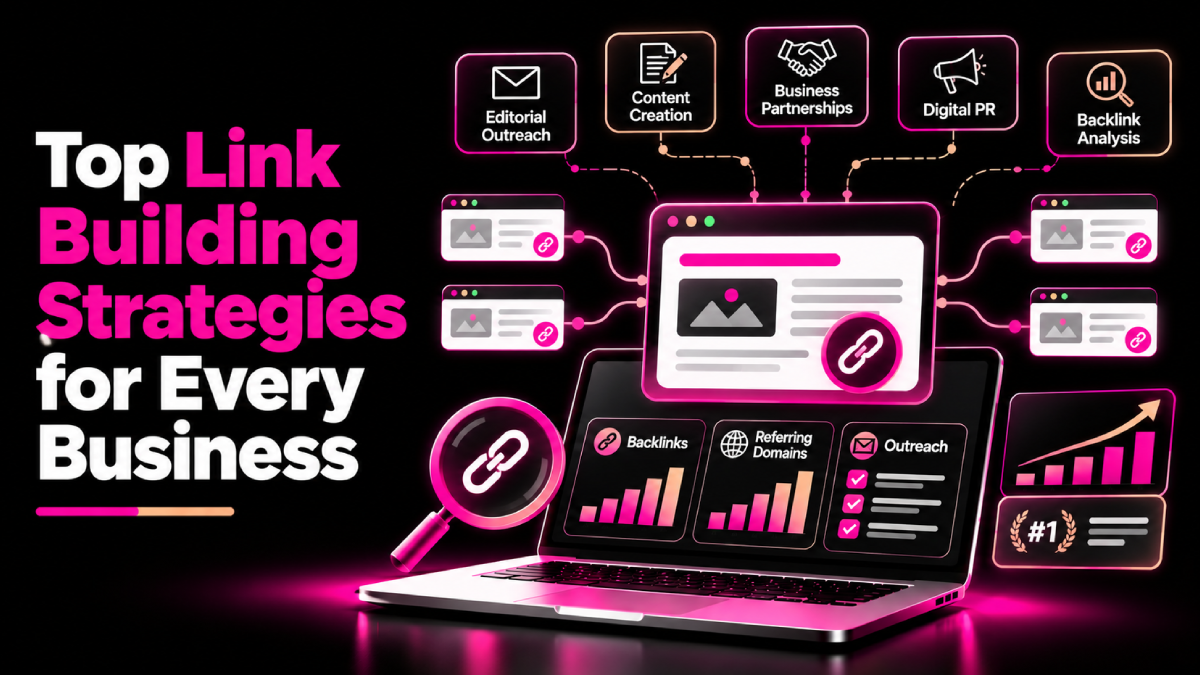
Top Link Building Strategies for Every Business
Building a website is only the beginning of SEO. To compete in search results, businesses also need to earn trust, publish useful content, and build relationships with relevant websites. That is where effective link building strategies for every business can make a difference.
Link building is the process of earning links from other websites to your own. These backlinks can help people discover your content, bring referral traffic, and provide search engines with useful signals about your pages.
However, not every backlink helps. Links from relevant, trustworthy websites are generally more valuable than large numbers of unrelated or low-quality links. The goal is to earn links naturally by giving people a genuine reason to reference your business.
In this guide, you will learn practical link building strategies that small businesses, SaaS companies, eCommerce stores, and service providers can use to build a sustainable SEO foundation.
What Is Link Building in SEO?
Link building involves earning backlinks from external websites that point to pages on your site. These links may appear in editorial articles, industry resources, original research, relevant business directories, or partner content.
Backlinks can help users discover your website and help search engines find pages across the web. Google’s link best practices guide explains how links support discovery and how descriptive anchor text helps users and search engines understand linked pages.
Still, link building is not about collecting as many links as possible. Relevance, editorial context, and the value of the linked page matter. A useful resource that earns a few relevant references can be more worthwhile than hundreds of links from unrelated sites.
Top Link Building Strategies for Every Business
1. Create Link-Worthy Content
The strongest starting point is content that other people genuinely want to reference. Instead of publishing another generic article, create something that helps readers solve a problem or understand a topic more clearly.
Useful formats include:
- Original industry research or surveys
- Practical guides and checklists
- Free calculators, templates, and tools
- Detailed case studies based on real results
- Expert interviews and data visualizations
For example, an accounting firm could publish a small-business tax preparation checklist. A SaaS company could create a free calculator related to its product. An eCommerce brand could produce a detailed buying guide.
Make the resource genuinely useful, then promote it to relevant journalists, publishers, industry communities, and professional organizations.
2. Use Guest Contributions Selectively
Writing for relevant industry publications can introduce your expertise to new audiences and help you build professional relationships.
Start by identifying publications that serve your target customers. Review their topics, editorial standards, audience, and contribution guidelines before pitching an idea.
A strong guest article should:
- Address a specific problem for the publication’s audience.
- Offer original insights or practical experience.
- Match the publication’s style and editorial standards.
- Include links only where they help readers understand the topic.
Do not publish low-value guest posts across unrelated sites simply to gain backlinks. Google identifies paid links that pass ranking credit and manipulative guest-post campaigns as potential link spam. Focus on editorial value rather than guaranteed link placement.
3. Build Relationships With Relevant Businesses
Partnerships can create natural opportunities for useful mentions and referrals. Consider businesses that serve the same audience without directly competing with you.
Examples include:
- A web design agency partnering with a branding consultant
- A software company collaborating with complementary software providers
- A local retailer working with a community organization
- A professional services firm contributing expertise to an industry association
Look for genuine collaboration opportunities, such as joint webinars, resource pages, interviews, or co-created research. Do not demand reciprocal backlinks or create pages solely to exchange ranking signals.
4. Find Unlinked Brand Mentions
Sometimes a website mentions your company, product, founder, or original research without linking to your site.
Use search engines, brand monitoring tools, and media monitoring services to identify these references. Check that the mention is accurate and relevant, then contact the publisher politely if a link would help readers find the source.
For example, if an industry article references your original research, you could ask the author to link to the research page for readers who want to review the findings.
Not every publisher will add a link, and that is fine. Keep the outreach factual, courteous, and free of pressure.
5. Reclaim Broken and Lost Links
A broken backlink points to a page that no longer works, while a lost backlink is a link that previously existed but has disappeared.
Use backlink analysis tools to identify these opportunities. Then check whether the referring page still provides relevant context.
Take the following steps:
- Confirm that the linking page is relevant and accessible.
- Check whether the destination on your website returns an error.
- Restore the original resource if appropriate, or redirect the old URL to a closely related replacement.
- If the referring site removed the link, contact its editor only when a useful replacement exists.
Do not redirect every outdated URL to your homepage. Redirect users to a relevant page or return the appropriate status code when no suitable replacement exists.
6. Earn Links Through Digital PR
Digital PR involves sharing newsworthy information, expertise, or resources with publishers and relevant media outlets.
Potential angles include original research, a useful industry survey, expert commentary, a product innovation, or a well-supported analysis of a current industry issue.
Before pitching, ask:
- Is the story relevant to the publication’s audience?
- Can I support the claims with reliable evidence?
- Does the resource add something new to the discussion?
- Can the journalist verify the information quickly?
Personalize each pitch and make the source material easy to review. Avoid mass emails with generic claims or press releases distributed primarily to generate keyword-rich backlinks.
7. Optimize Relevant Business Listings and Directories
Business directories can help customers discover your company, especially when you operate in a local market or a specialized industry.
Prioritize legitimate directories that your customers actually use, including relevant professional associations, local chambers of commerce, industry organizations, and established business platforms.
Keep your business name, address, phone number, website, and description accurate. Choose categories that reflect your real services.
Avoid submitting your site to hundreds of low-quality directories. Directory links should support discovery and trust, not serve as a shortcut for manipulating rankings.
8. Turn Existing Expertise Into Shareable Resources
You do not always need to create a new asset to earn links. Existing knowledge can become more useful through better presentation.
For example, you could turn common customer questions into a detailed guide, convert a genuine project into a case study, or organize several related articles into a comprehensive resource.
Then identify websites, educators, professional communities, and publishers that may find the resource useful. Reach out with a clear explanation of why it could help their readers.
You can also strengthen your site’s internal links. While internal links are not backlinks, they help visitors and search engines discover related content. For guidance on broader SEO improvements, explore how to rank on Google and AI search.
How to Measure Link Building Results
Measure the quality and business value of your efforts, not just the total number of backlinks.
Track these indicators:
- Relevant referring domains: How many distinct websites link to you?
- Link quality and context: Do the links appear on useful, relevant pages?
- Referral traffic: Do visitors arrive through those links?
- Target-page performance: Are the pages receiving links gaining visibility or engagement?
- Conversions: Do referral visitors complete meaningful actions?
- Link retention: Do earned links remain live over time?
Use Google Search Console and suitable backlink analysis tools to review performance. Remember that no individual metric guarantees ranking improvements.
Link Building Practices to Avoid
Google’s spam policies identify several link schemes that can put a website at risk.
Avoid:
- Buying links to manipulate search rankings
- Automated link-building programs that create artificial links
- Excessive reciprocal link exchanges
- Low-quality guest posts created primarily for backlinks
- Keyword-stuffed anchor text across unrelated sites
- Hidden links or mass-distributed links in templates and widgets
Paid advertising and sponsorship can be legitimate marketing activities. However, paid links should use appropriate attributes such as rel="sponsored" or rel="nofollow" when applicable so they do not pass ranking credit in violation of Google’s policies.
Conclusion
Sustainable link building starts with useful resources, relevant relationships, and outreach that respects publishers and readers. Choose strategies you can execute consistently, track the quality of the links you earn, and avoid shortcuts that violate search guidelines. By applying the right link building strategies for every business, you can improve content discovery, build industry relationships, and support a broader long-term SEO strategy.
FAQs About Top Link Building Strategies for Every Business
Quick answers related to this guide, and how SEOXREACH can help you apply them.
Start with useful content, genuine local and industry relationships, relevant business directories, and personalized outreach. Choose strategies that match your audience, resources, and expertise.
There is no fixed timeline. Results depend on the links earned, the pages involved, competition, content quality, and other SEO factors. Monitor progress over time rather than expecting immediate ranking changes.
Links remain useful for discovering content and understanding relationships between pages. However, backlinks are only one part of SEO. Relevant content, technical accessibility, and a good user experience also matter.
Buying links specifically to manipulate search rankings can violate Google's spam policies. If you pay for advertising or sponsorship, use appropriate link attributes and focus on the audience and promotional value.
There is no universal number. The links needed for a competitive query vary by topic, search intent, competing pages, and other factors. Focus on earning relevant links rather than meeting an arbitrary target.
Use Google Search Console's Links report to review links Google has identified, and consider reputable backlink analysis tools for additional discovery and comparison. Treat third-party authority and toxicity scores as estimates, not Google's own ranking measurements.
Ready to Grow Organically?
Get a custom SEO strategy to increase your traffic, leads and revenue with SEOXREACH.
Get a Free SEO Audit →- More Traffic
- Higher Rankings
- Increase Revenue