
Why Organic SEO Beats Paid Ads for Long-Term Growth
October 25, 2026
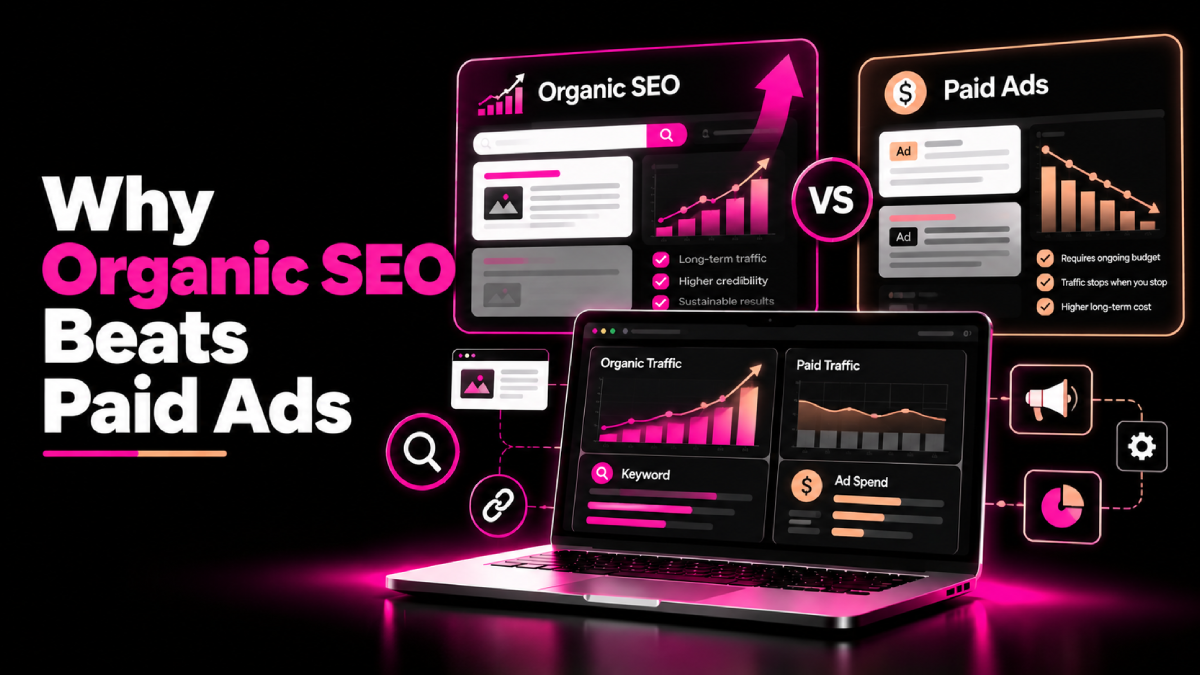
Every business wants a reliable way to attract customers without letting marketing costs spiral out of control. Paid advertising can bring visitors quickly, but those visits depend on your campaign budget. Organic search engine optimization (SEO), on the other hand, can help your website attract relevant visitors long after you publish and optimize your content.
So, why does organic SEO beat paid ads for long-term growth? The main advantage is its potential to build lasting visibility, useful content assets, and a more sustainable source of leads over time.
However, SEO is not free, and paid advertising is not ineffective. Both require investment, planning, and measurement. The right choice depends on your business goals, competition, budget, and timeline.
In this guide, you’ll learn how organic SEO compares with paid ads, where it offers an advantage, and how to build a strategy that supports sustainable business growth.
What is the Difference Between Organic SEO and Paid Ads?
Organic SEO improves your website’s visibility in unpaid search results through relevant content, technical improvements, internal linking, and credible external references.
Paid search advertising allows businesses to pay for ad placements when users search for selected keywords. In pay-per-click (PPC) campaigns, advertisers commonly pay when someone clicks an ad, depending on the campaign’s bidding model.
Here is how the two approaches compare:
| Factor | Organic SEO | Paid Ads |
|---|---|---|
| Initial results | Often take time | Can start generating traffic quickly |
| Traffic costs | Requires investment in content, expertise, and optimization | Requires an advertising budget and campaign management |
| Long-term value | Rankings and content may continue attracting visitors | Traffic usually falls when campaigns stop |
| Targeting | Based on relevance, content, and search visibility | Allows campaign-level audience, keyword, and location targeting |
| Trust and discovery | Can build credibility through useful organic results | Ads are labeled as advertising |
| Best use | Sustainable visibility and long-term acquisition | Immediate demand, promotions, and rapid testing |
Neither channel guarantees conversions. The strongest strategy depends on how well each channel reaches your audience and supports your business objectives.
5 Reasons Organic SEO Can Outperform Paid Ads Over Time
1. Organic SEO Can Build Long-Lasting Traffic
One of the biggest benefits of SEO is that a useful page can continue attracting visitors after its initial publication.
For example, a detailed guide answering a common customer question may rank for relevant searches for months or longer. You can improve that page as search intent changes, add supporting information, and connect it to related service pages.
Paid advertising works differently. Once a campaign stops serving, its paid traffic generally stops too.
To build this long-term advantage, focus on:
- Targeting relevant keywords with lasting demand.
- Creating useful, original content.
- Maintaining technically accessible pages.
- Updating information when it becomes outdated.
- Linking educational content to relevant products or services.
SEO still requires ongoing work. Rankings can fluctuate, competitors can improve their content, and search behavior can change. However, well-maintained content can become a valuable business asset rather than a traffic source that depends entirely on daily ad spend.
2. SEO Can Improve Acquisition Economics Over Time
Paid advertising costs can increase when competition for valuable keywords grows. Organic SEO also requires investment, but its economics can improve as your website earns relevant rankings and attracts traffic from multiple queries.
Consider a simple hypothetical example.
A business invests $3,000 in creating and optimizing a service page and supporting content. If those pages attract qualified visitors for several months, the original investment can continue generating opportunities without a separate payment for each organic click.
However, SEO is not cost-free. Content creation, technical improvements, link earning, and ongoing maintenance all require resources. Rankings may also take time to develop or fail to produce the expected results.
Compare both channels using the full cost of acquisition, including labor, tools, agency fees, advertising spend, lead quality, and conversion rates. This gives you a more realistic view than comparing the cost of a single click.
3. Helpful Organic Content Builds Credibility
People often research a problem before choosing a service provider. Organic content gives your business an opportunity to answer their questions before they are ready to buy.
A business that publishes accurate guides, useful comparisons, original insights, and detailed service information can demonstrate its knowledge and help customers make informed decisions.
For example, an SEO agency could publish a guide explaining technical SEO problems, how to diagnose them, and when professional help may be useful. Readers can evaluate the agency’s expertise before requesting a consultation.
Google’s guidance on helpful, reliable, people-first content supports creating original information that genuinely serves readers.
Paid ads can also build awareness and attract customers. However, useful organic content gives visitors a way to explore your expertise without requiring every interaction to begin with an advertisement.
4. SEO Reaches Customers at Different Stages of the Buying Journey
Not everyone who searches is ready to buy immediately. Some people are learning about a problem, others are comparing solutions, and some are looking for a provider.
SEO allows you to create content for each stage.
- Awareness: Publish educational guides that explain common problems.
- Consideration: Create comparison pages, detailed tutorials, and solution guides.
- Decision: Optimize service pages with clear deliverables, proof, and enquiry options.
For example, a business researching website performance might first discover an educational article, then explore a technical SEO service page, and finally request an audit.
Connect these pages through relevant internal links. SEOXREACH’s guide to ranking on Google and AI search provides another resource for understanding search visibility.
Paid campaigns can target different stages too, but SEO offers the opportunity to build a connected library of content that serves customers throughout their research process.
5. Organic SEO Can Support Multiple Marketing Channels
A strong SEO program can create assets that support your wider marketing strategy.
A well-researched article may provide material for email newsletters, social media posts, sales conversations, and downloadable resources. A useful comparison guide may help both search visitors and prospects referred by partners.
Likewise, a technically sound website and clear service pages can support conversions from organic search, paid campaigns, and direct traffic.
SEO therefore contributes more than rankings alone. It can improve the information customers encounter throughout their decision-making process.
For additional ideas, explore SEOXREACH’s guide to proven ways to boost organic traffic.
When Paid Ads Are the Better Choice
Organic SEO does not win in every situation. Paid advertising may be the better option when you need immediate visibility or want to test demand before investing heavily in content.
Paid ads can be useful when:
- You are launching a new product or service.
- You need leads within a short time frame.
- You are promoting a limited-time offer.
- You want to test different messages or landing pages.
- Organic rankings are not yet competitive for valuable searches.
Google’s official Google Ads budgeting guidance explains how advertisers can manage campaign spending.
Rather than choosing one channel exclusively, consider using paid ads to generate short-term demand while building SEO for longer-term visibility.
How to Build a Sustainable Organic SEO Strategy
Start with a focused plan rather than trying to optimize every page at once.
- Research search intent: Identify the questions and keywords your ideal customers use.
- Prioritize important pages: Improve your highest-value service pages and existing content.
- Fix technical barriers: Check indexing, internal links, mobile usability, and performance.
- Publish useful resources: Answer real customer questions with accurate, original information.
- Build relevant authority: Earn credible references through useful content and genuine relationships.
- Measure business outcomes: Track organic clicks, qualified leads, conversions, and revenue where possible.
Review performance regularly and refine your priorities based on evidence. SEO results can take time, so avoid judging the strategy solely by short-term fluctuations.
Conclusion
Organic SEO can outperform paid ads over the long term because it offers the opportunity to build lasting search visibility, useful content assets, and a connected journey from customer questions to service enquiries.
However, SEO is not automatic or free, and paid advertising remains valuable for immediate demand and campaign testing. The smartest strategy is to understand the role of each channel, measure its business impact, and invest where it produces the best results.
If your goal is sustainable growth, start by improving your website’s technical foundation, publishing genuinely useful content, and connecting relevant pages to your services. Over time, these efforts can help organic search become a meaningful source of qualified traffic and business opportunities.
FAQs About Why Organic SEO Beats Paid Ads for Long-Term Growth
Quick answers related to this guide, and how SEOXREACH can help you apply them.
Organic SEO can be better for building long-term search visibility and reducing dependence on paid clicks. Paid ads are often better for immediate exposure. The right choice depends on your goals, timeline, competition, and acquisition costs.
Organic clicks do not require a payment to Google for each visit, but generating that traffic still costs money or time. Content, technical SEO, expertise, tools, and maintenance all require investment.
There is no guaranteed timeline. Results depend on your website's condition, competition, content quality, search demand, and implementation. Measure progress over time rather than expecting immediate rankings.
Choose based on urgency and resources. If you need enquiries quickly, paid ads may help while you build SEO. If you can invest for the longer term, SEO can create a sustainable acquisition channel. Many businesses benefit from using both.
Sometimes, but not for every business. Organic search may cover many important queries, yet paid ads can still help with competitive keywords, seasonal promotions, or immediate demand. Review the performance of both channels before reallocating your budget.
Measure the full cost of SEO against qualified leads, customer acquisition, and revenue attributable to organic search. Include content production, technical work, agency fees, and ongoing maintenance to understand the real return.
Ready to Grow Organically?
Get a custom SEO strategy to increase your traffic, leads and revenue with SEOXREACH.
Get a Free SEO Audit →- More Traffic
- Higher Rankings
- Increase Revenue