
How to Rank on Google & AI
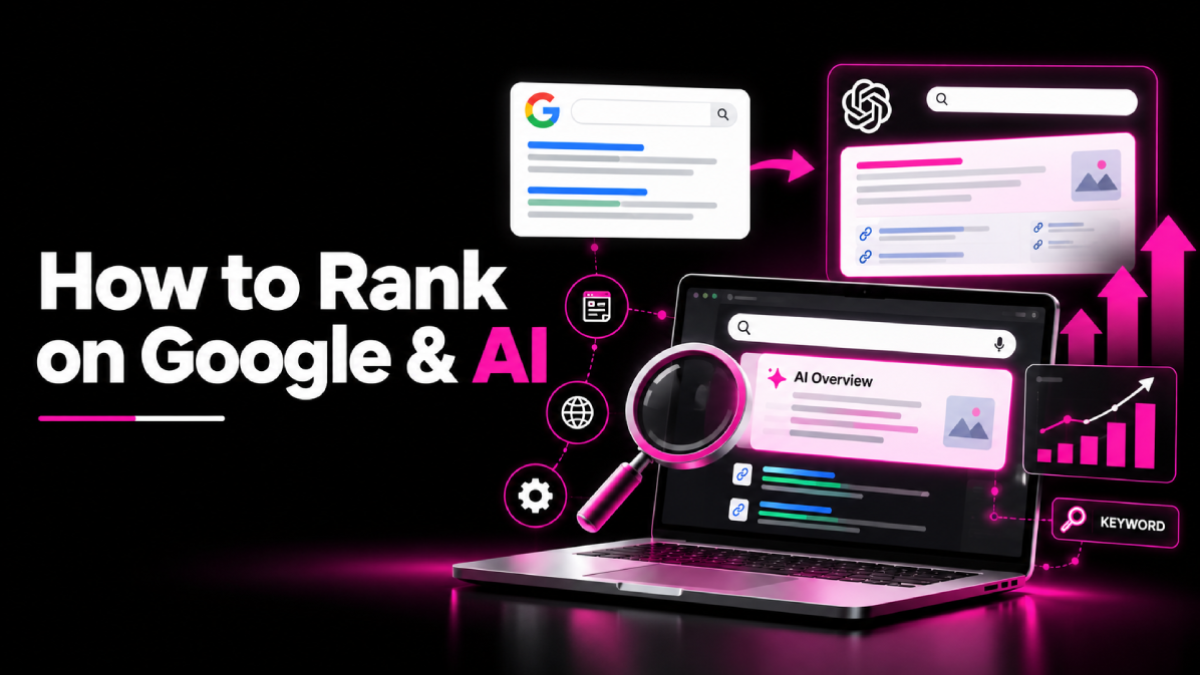
Ranking on Google is no longer just about earning a position among traditional blue links. Search results can also include AI Overviews, which summarize information and link to relevant websites.
For businesses, this creates an important opportunity. A well-optimized website can attract organic traffic while potentially earning visibility as a source in AI-generated answers.
However, how to rank on Google and AI Overviews requires more than adding keywords or publishing large volumes of content. You need a technically accessible website, useful information, clear page structure, and evidence of genuine expertise.
Google’s official guidance confirms that established SEO fundamentals remain relevant to AI search features. There is no guaranteed formula for inclusion, but you can take practical steps to improve your eligibility and strengthen your search visibility. Google’s AI search guidance explains these principles in detail.
How Do Google Rankings and AI Overviews Work?
Google’s traditional search results help users discover relevant web pages. AI Overviews provide AI-generated summaries for queries where Google determines that the feature can add value.
To generate these summaries, Google’s systems can draw on relevant information from its search index and display links to supporting pages. The sources shown may vary depending on the query and the information needed.
This distinction matters because ranking in traditional results does not guarantee a citation in an AI Overview. Likewise, appearing as a cited source does not guarantee a top organic position.
Your strategy should therefore address two related goals:
- Improve your website’s relevance, accessibility, and performance in organic search.
- Create trustworthy, useful content that can support answers to specific user questions.
7 Strategies to Rank on Google and AI Overviews
1. Match Search Intent Before Targeting Keywords
Start by understanding what users want when they enter a search query.
Someone searching for “what is technical SEO” needs an explanation. Someone searching for “technical SEO agency” may be comparing service providers. These queries require different content.
Before creating a page:
- Search your primary keyword on Google.
- Review the results, page types, and questions users encounter.
- Identify whether the intent is informational, commercial, navigational, or transactional.
- Create a page that fulfills that intent more effectively than a generic article.
Also consider related questions users might ask next. Cover relevant subtopics naturally rather than publishing separate pages for every minor keyword variation.
2. Create Helpful, Original Content
Content quality is central to sustainable SEO. Google encourages publishers to create original, useful information rather than content that simply repeats what other websites already say.
Improve your articles by including:
- Clear answers near the beginning of each section.
- Practical steps readers can apply.
- Original examples, observations, or documented results.
- Accurate facts and links to credible sources.
- Limitations, trade-offs, and explanations that help readers make decisions.
For example, an article about local SEO could explain how to audit a business profile, correct inconsistent contact details, and measure calls or enquiries. That provides more value than a list of generic ranking tips.
Use AI tools to assist with research or editing if helpful, but review the final content for accuracy, originality, and genuine usefulness.
3. Structure Pages for Readers and Search Engines
Clear organization makes information easier to navigate and understand.
Use one descriptive H1, followed by logical H2 and H3 headings. Keep paragraphs focused, explain unfamiliar terms, and use lists or tables when they improve comprehension.
For question-led content, answer the main question directly before expanding on the details.
For example, a section titled “How Do You Improve AI Overview Visibility?” should begin with a concise explanation, followed by the practical actions readers can take.
This structure benefits readers and can make key information easier to identify. However, no specific heading format or paragraph length guarantees an AI citation.
4. Fix Technical SEO Issues
Search engines need to access and process your pages before they can consider them for relevant search results.
Audit these technical essentials:
- Check indexing status in Google Search Console.
- Ensure important pages return successful HTTP responses.
- Review robots.txt and meta robots directives for accidental blocking.
- Submit an accurate XML sitemap.
- Add contextual internal links to important pages.
- Make sure essential content is available as crawlable text.
- Improve mobile usability and page performance.
- Fix broken links, redirect chains, and unnecessary duplicate URLs.
Google states that pages must meet its technical requirements and be eligible to appear in Search to qualify for AI Overview links. Even then, crawling, indexing, and display are not guaranteed.
5. Build Topic Authority and Relevant Backlinks
Cover your core subject in enough depth to help readers solve connected problems.
For example, a digital marketing agency could develop a related content cluster covering keyword research, technical SEO, content optimization, local SEO, and AI search visibility.
Connect these articles using relevant internal links. Then link supporting articles to appropriate service pages where readers can take the next step.
Also earn backlinks through original research, useful resources, industry contributions, and genuine professional relationships. Relevant editorial links can support your website’s reputation, but avoid buying manipulative links or relying on artificial mentions as a shortcut to AI visibility.
6. Use Structured Data Correctly
Structured data helps search engines interpret eligible information about a page. Depending on the page type and applicable guidelines, it may also support specific search features.
For example, appropriate Article or Organization markup can help describe content or business information.
Follow three rules:
- Use markup that accurately describes the visible page.
- Validate the implementation with Google’s available testing tools.
- Follow the requirements for the relevant search feature.
Importantly, Google does not require special AI-specific schema markup to appear in AI Overviews. Adding structured data alone will not secure rankings or citations.
7. Monitor Performance and Improve Existing Pages
SEO requires ongoing measurement rather than one-time publishing.
Use Google Search Console to track impressions, clicks, queries, and page performance. Review which pages attract relevant visitors and which queries present opportunities for improvement.
As available in your account, use Google’s dedicated generative AI performance reporting to assess visibility in supported AI search experiences.
Then:
- Identify pages with strong impressions but weak click-through rates.
- Improve titles and descriptions when they accurately reflect the content.
- Update outdated information and add useful missing details.
- Strengthen internal links to important pages.
- Compare performance over time instead of reacting to daily fluctuations.
Measure business outcomes, too. Qualified leads, purchases, sign-ups, and enquiries provide more useful evidence of SEO value than rankings alone.
Common Mistakes That Limit Google and AI Overview Visibility
Avoid these approaches when optimizing your website:
- Keyword stuffing: Repeating a phrase unnaturally weakens the reading experience.
- Publishing generic articles at scale: More content does not automatically mean better visibility.
- Ignoring indexing problems: Valuable content cannot perform as intended if search engines cannot access it.
- Inventing expertise or statistics: Unsupported claims undermine trust.
- Chasing AI shortcuts: No special file, schema type, or content trick guarantees an AI Overview citation.
- Ignoring conversions: Traffic has limited business value if it does not reach the right audience.
Instead, focus on the quality of your information, your website’s technical health, and the needs of your target customers.
Conclusion
Learning how to rank on Google and AI Overviews starts with a strong SEO foundation. Understand search intent, publish original and trustworthy content, maintain a technically accessible website, build relevant topic coverage, and measure performance consistently.
AI Overviews introduce another way for users to discover information, but they do not replace the need to serve readers well. Focus on creating pages that answer real questions and help people make informed decisions.
With a consistent approach to how to rank on Google and AI Overviews, your business can strengthen its organic search presence and improve its chances of being discovered across evolving search experiences. No strategy can guarantee a particular position or citation, but useful content and sound SEO practices provide a sustainable foundation.
FAQs About How to Rank on Google & AI
Quick answers related to this guide — and how SEOXREACH can help you apply them.
A new website may become eligible if its pages meet Google's technical requirements and provide relevant, useful information. However, eligibility does not guarantee indexing, ranking, or inclusion in AI Overviews.
No. Start with strong SEO fundamentals and helpful, original content. You generally do not need to create separate articles solely for AI Overviews.
There is no fixed timeline. Results depend on competition, website history, technical health, content quality, and other factors. Monitor performance over time and improve your strategy using actual search data.
Ready to Put This Strategy to Work?
Book a free audit with SEOXREACH. We will show you exactly how to turn these insights into rankings, leads, and revenue.