
How to Drive High-Intent B2B Sales Leads
November 2, 2026
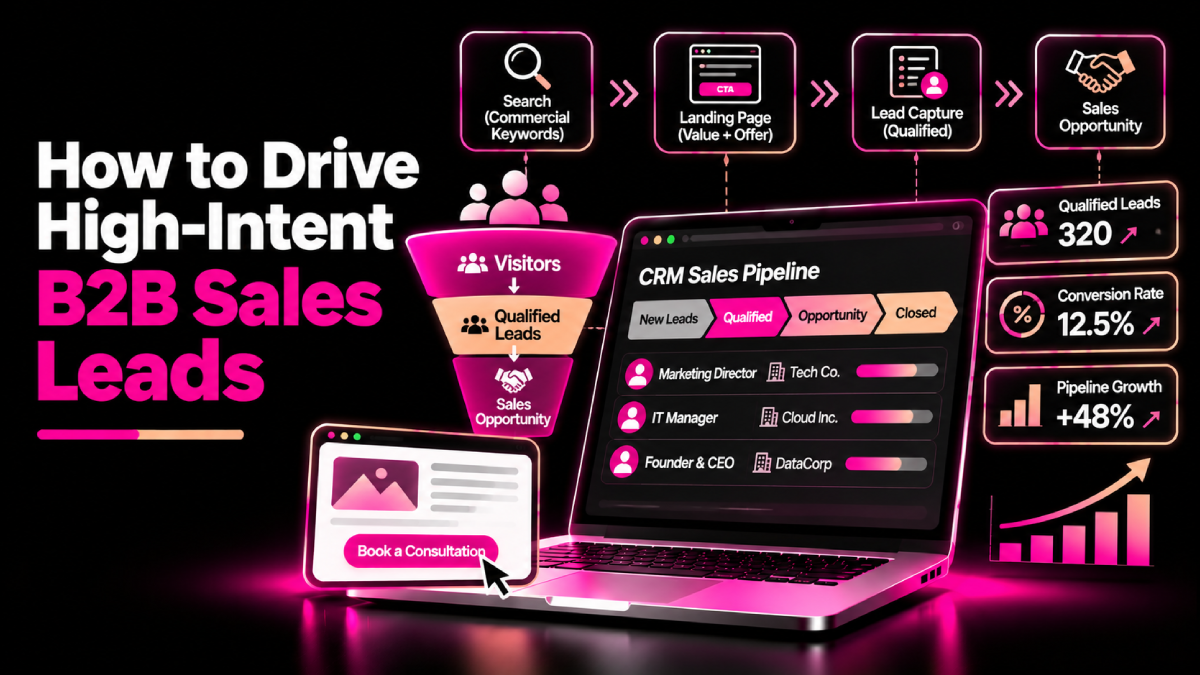
Generating website traffic is useful, but traffic alone does not grow a B2B business. The real opportunity comes from attracting people who have a clear business problem, understand their needs, and are actively evaluating solutions.
Learning how to drive high-intent B2B sales leads helps your business focus on prospects who are more likely to become qualified opportunities. Instead of chasing every visitor, you can build a strategy around buyer needs, search intent, useful content, and conversion-focused landing pages.
This guide explains how to attract relevant B2B prospects, identify buying signals, and turn qualified website visits into meaningful sales conversations.
What are High-Intent B2B Sales Leads?
High-intent B2B leads are potential business customers who show meaningful interest in purchasing a product or service. They may compare vendors, request pricing, explore implementation options, or contact a sales team.
For example, someone searching for “what is CRM software” may still be learning about the category. Someone searching for “CRM software pricing for a 50-person sales team” may be closer to evaluating a purchase.
However, one search or website visit does not prove buying readiness. Consider a prospect’s business needs, role, engagement, and stated timeline before qualifying the opportunity.
How to Drive High-Intent B2B Sales Leads
1. Define Your Ideal Customer Profile
Before investing in marketing, identify the businesses most likely to benefit from your solution.
Build an ideal customer profile (ICP) around factors such as:
- Industry and business model
- Company size and growth stage
- Geographic market
- Problems your product or service solves
- Typical budget and implementation needs
- Decision-makers and buying stakeholders
For example, a B2B SEO agency might focus on SaaS companies that need qualified organic traffic but lack an experienced internal SEO team.
A clear ICP helps you choose relevant keywords, create useful content, and avoid attracting visitors who are unlikely to become customers.
2. Target Keywords That Signal Buying Intent
Keyword research helps uncover what potential buyers want to learn, compare, or purchase. For B2B lead generation, prioritize keywords that connect directly to your offering.
Useful keyword categories include:
- Problem-focused: reduce customer acquisition costs, improve sales pipeline quality
- Solution-focused: B2B lead generation services, enterprise SEO services
- Comparison-focused: SEO agency vs in-house team, marketing automation platforms comparison
- Commercial: B2B SEO pricing, enterprise lead generation agency
- Action-focused: book a consultation, request an SEO audit
Review search results before choosing a page format. A comparison query may need a detailed evaluation guide, while a service-related query may need a dedicated landing page.
You can strengthen this process with a structured global content strategy that aligns topics with audience needs and commercial objectives.
3. Create Content for Every Buying Stage
B2B buyers rarely make complex purchasing decisions after reading one page. They often research the problem, compare possible solutions, evaluate vendors, and seek approval from other stakeholders.
Create content for each stage:
- Awareness: educational guides that explain business problems and possible solutions
- Consideration: comparison articles, implementation guides, and practical case studies
- Decision: service pages, pricing information, demonstrations, and consultation offers
For example, a software company could publish an educational guide, follow it with a feature comparison, and direct qualified readers to a product demonstration page.
Use your existing SEO resources to connect related topics and help readers move naturally toward relevant services.
4. Build Landing Pages Around Specific Buyer Needs
A landing page should make it easy for a prospective customer to understand what you offer, who it helps, and what to do next.
Include these essential elements:
- A clear headline focused on the buyer’s problem
- A concise explanation of your solution
- Specific benefits and relevant use cases
- Evidence such as genuine case studies, testimonials, or credentials
- A clear call to action
- A simple, accessible enquiry form
Avoid vague claims such as “We deliver the best results.” Explain what you do, how your process works, and what a potential client can reasonably expect.
Create separate landing pages for genuinely different services or audiences. Do not create large numbers of nearly identical pages simply to target keyword variations.
5. Offer Valuable Lead Magnets
Some B2B prospects need more information before they are ready to speak with sales. A useful resource can help them evaluate their situation and give you an appropriate way to continue the conversation.
Consider offering:
- Industry-specific checklists
- ROI or cost calculators
- Practical templates
- Original research reports
- Implementation guides
- Website or process audits
Match the resource to the audience. A technical SEO checklist may attract marketing managers, while a cost calculator may help a finance or operations stakeholder evaluate a purchase.
Keep forms proportionate to the value offered. Request only the information you need, explain how you will use it, and obtain appropriate consent for marketing communications.
6. Use Paid Campaigns to Reach Relevant Buyers
Paid search and professional-network advertising can help B2B businesses reach selected audiences and test commercial messaging.
For search campaigns, consider keywords that indicate a need for a provider or solution. Add negative keywords to reduce irrelevant clicks, and direct each ad to a landing page that matches its promise.
For professional-network campaigns, use relevant audience criteria such as industry, job function, seniority, or company characteristics where the platform supports them.
Track qualified leads and sales opportunities, not just clicks or form submissions. A campaign that produces many low-quality enquiries may deliver less value than one that produces fewer, better-qualified prospects.
7. Qualify Leads Before Passing Them to Sales
Not every enquiry deserves the same level of sales attention. Create a simple qualification process based on fit, need, and readiness.
Evaluate factors such as:
- Does the company fit your ideal customer profile?
- Does the prospect have a problem your offering solves?
- Is the person involved in the purchasing decision?
- Does the prospect have a realistic budget or buying process?
- Is there a clear timeline or agreed next step?
Use a CRM to record lead sources, interactions, qualification status, and follow-up tasks. Agree on lead definitions between marketing and sales so both teams evaluate quality consistently.
Avoid treating a single page view or email open as definitive proof of purchase intent.
8. Measure the Metrics That Matter
Build a reporting process that connects marketing activity to revenue outcomes.
Track:
- Qualified leads by source and campaign
- Lead-to-opportunity conversion rate
- Cost per qualified lead
- Sales acceptance rate
- Opportunity-to-customer conversion rate
- Customer acquisition cost
- Revenue influenced by organic and paid channels
Review these metrics by audience, landing page, and campaign where your data supports meaningful comparisons. Use the findings to improve targeting, content, forms, and follow-up.
Google’s Analytics documentation can help you configure measurement for your website and conversion journeys.
Common B2B Lead Generation Mistakes to Avoid
Avoid these frequent mistakes:
- Targeting broad keywords without considering buying intent
- Sending every visitor to the homepage
- Offering generic content that attracts the wrong audience
- Collecting too much information on lead forms
- Measuring success through traffic and form fills alone
- Ignoring lead follow-up and sales feedback
- Making unsupported claims about results
Instead, align your targeting, content, landing pages, and sales process around the needs of your ideal customer.
Conclusion
Sustainable B2B growth comes from attracting the right prospects, addressing their needs, and making the next step clear. Define your ideal customer, target buying-intent keywords, create useful content, improve landing pages, and measure qualified opportunities. When you apply a structured strategy to drive high-intent B2B sales leads, you can build a more focused pipeline and make better decisions about where to invest your marketing budget.
FAQs About How to Drive High-Intent B2B Sales Leads
Quick answers related to this guide, and how SEOXREACH can help you apply them.
Start with a clearly defined ideal customer profile, target relevant commercial keywords, build focused landing pages, and measure qualified opportunities. The best channel depends on your market, sales cycle, and available resources.
SEO can attract prospects who are actively researching business problems and solutions. Results depend on search demand, competition, content quality, and how well your pages convert relevant visitors.
SEO, paid search, professional-network advertising, industry partnerships, email outreach, and referral programs can all contribute. Test channels against qualified leads and revenue rather than assuming one channel will work for every business.
Define qualification criteria, align marketing with sales, use relevant landing pages, and collect enough information to assess fit. Review which lead sources produce real opportunities and paying customers.
A lead has shown some interest in your business. A qualified lead also meets agreed criteria related to customer fit, business need, and potential readiness to purchase.
Timelines vary by industry, sales cycle, channel, and offer. Paid campaigns can generate enquiries quickly, while SEO often requires sustained effort. Measure progress through lead quality and pipeline development over time.
Ready to Grow Organically?
Get a custom SEO strategy to increase your traffic, leads and revenue with SEOXREACH.
Get a Free SEO Audit →- More Traffic
- Higher Rankings
- Increase Revenue