
How to Optimize Content for AI Search
October 30, 2026
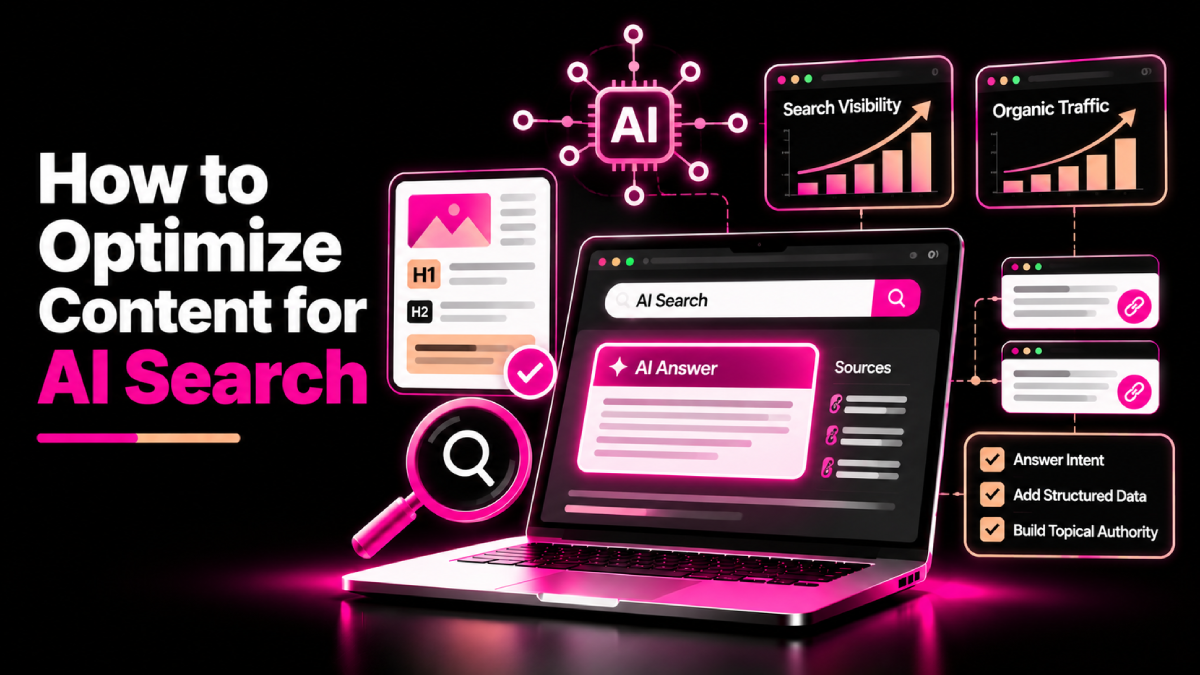
Search is changing. People increasingly use AI-powered search experiences to explore topics, compare solutions, and find answers. For businesses, learning how to optimize content for AI search can help build visibility across traditional search results and emerging AI experiences.
However, AI search optimization is not about finding secret prompts or adding special tags to every page. Google explains that its AI search features rely on existing search systems and established SEO fundamentals. Strong content, clear website structure, and accessible pages remain essential.
In this guide, you will learn practical ways to make your content more useful, understandable, and discoverable while building a sustainable SEO strategy.
What is AI Search Optimization?
AI search optimization means improving your website and content so AI-powered search experiences can discover, understand, and potentially reference your information.
These experiences include Google’s AI Overviews and AI Mode, as well as conversational search tools that provide answers with links to sources.
Traditional SEO remains an important foundation. Google states that pages generally need to be indexed and eligible to appear with a snippet in Google Search to be eligible for supporting links in its AI search features. Even then, inclusion is not guaranteed.
For further context, read Google’s official guide to optimizing for generative AI search.
How to Optimize Content for AI Search Step by Step
1. Answer the Main Question Clearly
Start each page by identifying the problem your audience wants to solve. Give readers a direct, accurate answer before expanding into detailed explanations.
For example, an article about local SEO should explain what local SEO does and why businesses use it before moving into advanced tactics.
Use this structure:
- Introduce the problem or question.
- Provide a concise, useful answer.
- Explain the reasoning behind that answer.
- Add steps, examples, and relevant caveats.
- Link to supporting resources where they add value.
Clear answers help readers understand the page quickly. They do not guarantee that an AI system will quote or cite your content, but they make the information easier to use.
2. Create Original, Helpful Content
AI search systems can draw from many sources. Therefore, publishing another generic summary of information already available online may offer little reason for readers to choose your page.
Add value through:
- First-hand experience and practical examples
- Original research or verified data
- Expert commentary with clear context
- Detailed explanations of difficult concepts
- Real processes, lessons, and limitations
For example, instead of publishing a generic article about website speed, explain how to identify a slow page, diagnose the cause, select a suitable fix, and verify the result.
Google’s helpful content guidance encourages original, reliable, people-first content that provides meaningful value.
3. Organize Content With Clear Headings
A logical structure helps visitors navigate your content and understand how each section relates to the main topic.
Use one clear H1 for the page title, H2 headings for major sections, and H3 headings for supporting points when appropriate.
Also:
- Keep paragraphs focused on one main idea.
- Use numbered steps for processes.
- Use bullet points for related items.
- Explain unfamiliar terms before using them repeatedly.
- Include tables when they genuinely make comparisons easier.
You do not need to split every paragraph into tiny sections for AI. Google specifically advises against unnecessary content chunking. Choose a structure that suits the subject and helps people read comfortably.
4. Cover Search Intent and Related Questions
People often explore a topic through several connected questions. Address the questions that naturally help readers complete their task instead of creating a separate page for every possible search variation.
For an article about AI search optimization, useful supporting questions might include:
- How does AI search differ from traditional search?
- Does technical SEO still matter?
- How can a business measure AI search visibility?
- What makes content useful and trustworthy?
Use keyword research, customer conversations, search results, and your own website data to identify relevant questions.
Then group related questions into a coherent guide. Create separate pages only when a topic deserves its own distinct treatment.
5. Strengthen Trust and Demonstrate Expertise
Trust matters when people rely on content to make decisions. Make it easy for readers to understand who created the content, how claims were developed, and where supporting evidence comes from.
Practical steps include:
- Identify the author or responsible organization where appropriate.
- Cite reliable primary sources for factual claims.
- Verify statistics, quotations, and technical recommendations.
- Explain methods behind original research.
- Keep time-sensitive information current.
- Correct mistakes and remove unsupported claims.
For topics involving finance, health, law, or other consequential decisions, use qualified expertise and authoritative sources. Do not invent credentials, case studies, or performance results to make a page appear more credible.
6. Apply Strong Technical SEO Fundamentals
Useful content cannot contribute to search visibility if search engines cannot access or understand the page properly.
Review the following:
- Ensure important pages are crawlable and can be indexed.
- Avoid accidentally blocking relevant content in robots.txt or through page-level directives.
- Add internal links so visitors and crawlers can discover related pages.
- Use descriptive page titles and URLs.
- Make important information available as readable text.
- Ensure mobile pages work correctly.
- Improve loading speed and page stability.
- Keep canonical URLs and redirects consistent.
Structured data can help search engines interpret eligible content and support certain search features. However, Google does not require special AI schema or other AI-specific markup for inclusion in AI Overviews or AI Mode.
You can explore SEOXREACH’s Answer Engine Optimization services for support with content discoverability and search visibility.
7. Use Images, Videos, and Structured Data Appropriately
Text is important, but other formats can make information easier to understand.
Add original diagrams, screenshots, demonstrations, or videos when they genuinely support the subject. Write descriptive alt text for meaningful images and provide captions or transcripts when useful.
Use structured data only when it accurately describes visible page content and matches Google’s supported guidelines. Test relevant markup before publishing.
Avoid adding schema simply because someone claims it guarantees AI citations. It does not.
8. Measure AI Search Visibility and Business Results
Do not judge your strategy solely by whether an AI tool mentions your brand in a few manual tests. AI responses can vary by query, context, location, and time.
Instead, establish a consistent measurement process:
- Monitor search impressions, clicks, and landing pages in Google Search Console.
- Review referral traffic from AI platforms in your analytics reports where available.
- Track qualified enquiries, signups, and sales from relevant landing pages.
- Record brand mentions and citations using a consistent set of queries and monitoring methods.
- Review which content attracts useful traffic and update it based on evidence.
Google’s AI optimization guidance also describes reporting for generative AI performance in Search Console. Check the current reporting options available to your property.
For a broader approach, explore how to rank on Google and AI search and the SEOXREACH AI SEO services.
Common AI Search Optimization Mistakes
Avoid tactics that promise easy AI citations without addressing content quality.
- Publishing large volumes of repetitive, low-value AI-generated pages
- Adding keywords unnaturally to every heading
- Creating artificial brand mentions across unrelated websites
- Adding unsupported statistics or invented expert opinions
- Assuming a perfect technical score guarantees visibility
- Building special AI files or markup based on unsupported ranking claims
Google’s guidance says that files such as llms.txt do not improve visibility in Google Search’s generative AI features. Prioritize useful content and established SEO practices before experimenting with optional tools for other systems.
Conclusion
Successful AI search optimization starts with useful content, trustworthy information, clear structure, and accessible web pages. Focus on solving real user problems, supporting claims with reliable evidence, and measuring the results over time. When you understand how to optimize content for AI search, you can strengthen your website’s search foundation and improve its opportunity to be discovered across evolving search experiences.
FAQs About How to Optimize Content for AI Search
Quick answers related to this guide, and how SEOXREACH can help you apply them.
No. Traditional SEO remains the foundation for Google AI search visibility. Helpful content, crawlability, indexing, internal links, and a good user experience continue to matter.
Create original, accurate content that answers relevant questions clearly. Maintain sound technical SEO and provide useful supporting information. No method guarantees inclusion or citation.
No. Google does not require special AI-specific structured data for AI Overviews or AI Mode. Use supported structured data where it fits your content and search goals.
Not automatically. Focus on accuracy, originality, usefulness, and people-first intent. Mass-producing content primarily to manipulate rankings can violate Google's spam policies, regardless of the production method.
Use Google Search Console, analytics reports, and consistent brand-mention or citation monitoring where available. Track meaningful traffic and conversions alongside visibility indicators.
No. Group related questions when one comprehensive page can answer them well. Create separate pages when the topics have distinct intent and each page offers independent value.
Ready to Grow Organically?
Get a custom SEO strategy to increase your traffic, leads and revenue with SEOXREACH.
Get a Free SEO Audit →- More Traffic
- Higher Rankings
- Increase Revenue