
Scale Your Business With Google Ads
November 3, 2026
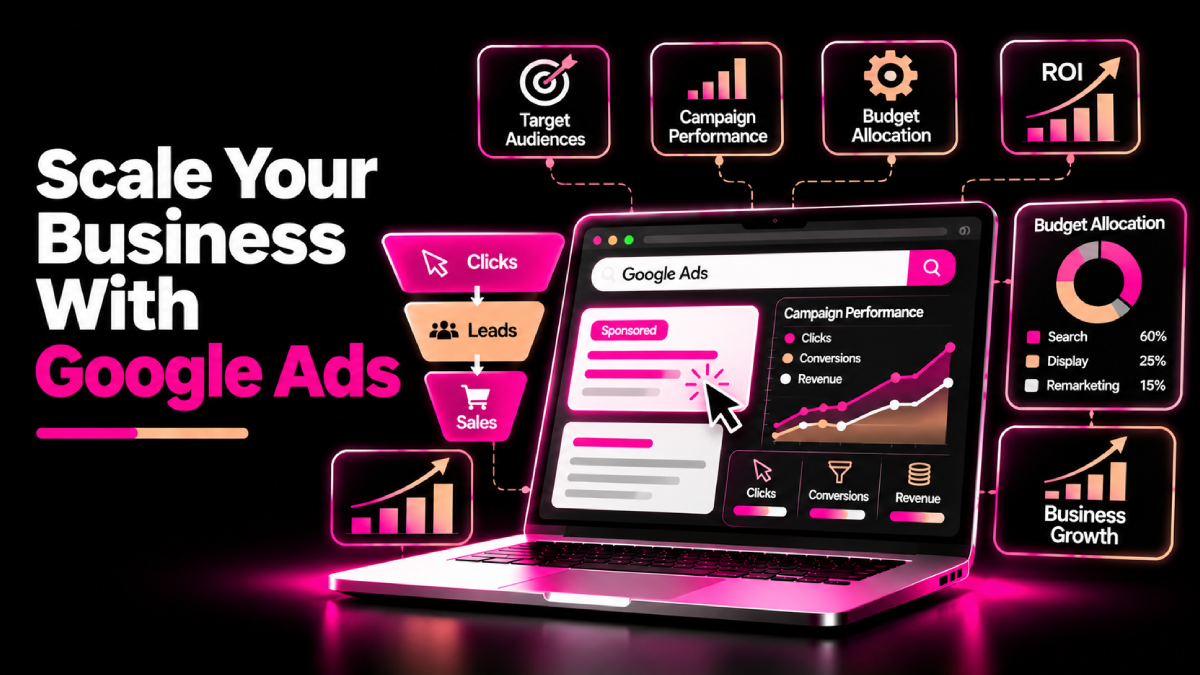
Growing a business requires more than attracting website visitors. You need to reach people who are actively searching for your products or services, turn their interest into meaningful actions, and invest your marketing budget where it can support profitable growth.
When managed strategically, Google Ads can help you scale your business with Google Ads by connecting your offerings with relevant searches and giving you measurable data to improve campaigns over time.
However, increasing your budget alone does not guarantee more customers. Sustainable growth depends on targeting, conversion tracking, landing page quality, campaign structure, and the economics of your business.
This guide explains how to build a Google Ads strategy that supports controlled growth while reducing wasted spend.
Why Google Ads Can Help Your Business Grow
Google Ads allows businesses to promote products and services across Google’s advertising network. Search campaigns can reach users when they search for relevant solutions, while other campaign types can support product discovery, remarketing where permitted, and broader audience reach.
Businesses can use Google Ads to:
- Reach people searching for specific products or services.
- Test new markets and commercial offers.
- Generate leads, enquiries, bookings, or online sales.
- Measure campaign performance using conversion data.
- Adjust budgets and targeting based on business results.
Paid advertising can generate visibility quickly after campaigns become eligible to serve, but performance depends on competition, targeting, budget, and landing page quality. Treat paid search as a measurable growth channel rather than a guaranteed source of profit.
How to Scale Your Business With Google Ads
1. Set Clear Business Goals Before Launching
Start by deciding what successful growth means for your business. A lead-generation company may prioritize qualified enquiries, while an eCommerce store may focus on profitable purchases.
Define your primary conversion before building campaigns. Examples include:
- A completed purchase
- A qualified lead form
- A booked consultation
- A completed appointment
- A valuable phone enquiry
Next, establish a baseline for conversion rate, customer acquisition cost, and revenue or pipeline value. These metrics help you decide whether to scale, optimize, or pause a campaign.
Avoid treating impressions, clicks, or inexpensive leads as proof of success unless they contribute to your business objectives.
2. Target High-Intent Keywords
For Search campaigns, keyword selection helps determine which searches may trigger your ads. Focus on phrases that connect directly to your offering and the problem you solve.
For example, a digital marketing agency could target searches such as:
- Google Ads management services
- PPC agency for small businesses
- Google Ads campaign audit
- B2B lead generation advertising
Separate commercial searches from broad informational queries where appropriate. Use Google’s keyword planning tools to explore search demand and estimate potential costs, then review actual search terms after your campaign starts running.
Add negative keywords when they prevent irrelevant searches from triggering your ads. Review them regularly because an overly broad exclusion can block useful traffic.
The objective is not to attract the largest possible audience. It is to reach people whose needs match your products, services, and sales process.
3. Structure Campaigns Around Clear Objectives
A clear campaign structure makes it easier to manage budgets, evaluate performance, and align ads with landing pages.
Organize campaigns around meaningful differences, such as:
- Product or service categories
- Customer segments
- Geographic markets
- Separate business objectives
- Different conversion values or sales cycles
Keep related keywords and ads together when they share the same intent. Write ad copy that reflects the searcher’s needs and clearly explains the next step.
Avoid splitting campaigns into many tiny groups without a practical reason. Excessive complexity can make analysis and management harder.
4. Build Landing Pages That Convert
Even well-targeted ads can waste money if the destination page fails to answer the visitor’s questions.
A strong landing page should include:
- A headline that matches the ad’s promise
- A clear explanation of the offer
- Relevant benefits and use cases
- Genuine testimonials, credentials, or case studies
- A prominent call to action
- A simple form or checkout process
- Fast, accessible mobile functionality
For example, an ad promoting an SEO audit should lead to a page explaining the audit, its scope, and how to request one—not a generic homepage.
Keep the conversion process simple, remove unnecessary distractions, and test meaningful changes. Review your SEOXREACH website resources for ideas on improving landing page content and search visibility.
5. Set Up Accurate Conversion Tracking
Conversion tracking helps you understand what happens after someone clicks an ad. Without reliable data, you may increase spend on campaigns that generate clicks but few valuable outcomes.
Configure tracking for your main business goals and verify that events fire correctly. Depending on your setup, you may use Google Ads conversion tracking, Google Analytics, or supported integrations.
Check that:
- Purchases record the correct transaction values.
- Lead forms count completed submissions rather than page visits alone.
- Duplicate events do not inflate results.
- Phone calls are measured appropriately where relevant.
- Consent and privacy requirements are respected.
- Qualified leads and offline sales can be imported where your systems support them.
For B2B companies with long sales cycles, connect marketing data with CRM outcomes when possible. This helps you distinguish raw enquiries from qualified opportunities and closed revenue.
6. Choose Bidding Strategies Based on Your Data
Google Ads offers automated bidding strategies that use different signals to pursue campaign goals. The right choice depends on the objective, tracking setup, and amount and quality of available conversion data.
For example:
- Maximize Clicks can help drive visits within a budget, but clicks alone do not establish business value.
- Maximize Conversions aims to generate conversions within the campaign’s budget.
- Target CPA aims to achieve conversions around a specified average acquisition cost.
- Target ROAS aims to optimize conversion value relative to advertising spend when suitable value data is available.
Do not select a strategy simply because it sounds more advanced. Establish accurate tracking first, understand your economics, and review the current requirements and recommendations in Google’s documentation.
7. Scale Budgets Gradually
Once a campaign delivers consistent, relevant results, assess whether it can support additional spend.
Before raising the budget, review:
- Cost per qualified lead or purchase
- Conversion rate and conversion value
- Available search demand
- Impression share and lost impression share, where relevant
- Sales capacity and fulfilment constraints
- Profit margins and customer lifetime value, where reliably measured
Increase budgets in controlled steps and observe how performance changes. Avoid making frequent, large changes that make results difficult to interpret.
If costs rise or lead quality falls, investigate the cause before spending more. You may need to improve targeting, update ads, adjust landing pages, or refine conversion measurement instead.
8. Use Remarketing and Other Campaign Types Carefully
Search campaigns can capture existing demand, while other campaign types may help businesses reach potential customers earlier in their decision process.
Depending on your goals, consider Shopping campaigns for eligible product feeds, Performance Max for eligible inventory across Google’s channels, or audience-based campaigns where appropriate.
Remarketing can re-engage eligible previous visitors, subject to platform policies, consent requirements, and audience eligibility.
Start with a clear hypothesis for each additional campaign. Measure incremental business value rather than assuming every additional channel will improve results.
9. Review Performance and Keep Improving
Set a regular schedule to review campaign data. The right frequency depends on spend, conversion volume, sales cycle, and campaign stability.
Monitor:
- Search terms and irrelevant traffic
- Cost per conversion and qualified lead rate
- Conversion value and return on ad spend
- Ad and landing page performance
- Geographic and device differences
- Changes in sales quality and revenue
Test one meaningful change at a time when practical. Keep a record of what changed and what happened afterward.
Use Google’s Google Ads Help Center to check current campaign settings, conversion measurement, and bidding guidance.
Common Google Ads Scaling Mistakes to Avoid
Avoid these mistakes when expanding campaigns:
- Increasing spend before confirming conversion tracking
- Targeting broad keywords without reviewing search intent
- Sending every ad to the same generic landing page
- Judging campaigns by clicks rather than business outcomes
- Changing budgets and bidding settings too frequently
- Expanding into new campaign types without a clear objective
- Ignoring lead quality, margins, and fulfilment capacity
Scaling works best when your marketing system can handle the additional demand and your data supports the decisions you make.
Conclusion
Google Ads can support business growth when campaigns connect relevant searches with clear offers, accurate conversion tracking, and landing pages designed to convert. Start with measurable goals, improve campaign quality, and increase spending only when performance and business economics support it. A disciplined approach to scale your business with Google Ads can help you make more informed advertising decisions and build a more sustainable acquisition strategy.
FAQs About Scale Your Business With Google Ads
Quick answers related to this guide, and how SEOXREACH can help you apply them.
Your budget depends on competition, target geography, conversion costs, margins, and sales goals. Start with a budget your business can afford to test, then increase it as reliable results justify additional investment.
Some campaigns can generate leads soon after they begin serving, but results vary. Tracking, competition, search demand, offer quality, and landing page performance all influence outcomes.
Yes. Small businesses can target relevant services, locations, and search terms. Start with a focused offer and manageable budget, then measure qualified enquiries and sales rather than trying to compete for every keyword.
Not automatically. Check whether conversions are valuable, acquisition costs remain acceptable, and your business can fulfil additional demand. Scale gradually and monitor the impact.
Conversions usually provide a closer connection to business goals, but their value depends on quality. For lead-generation campaigns, qualified leads and resulting sales are often more useful measures than raw form submissions.
Not always. Businesses with the right skills, time, and measurement setup can manage campaigns internally. An experienced specialist may help when campaign complexity, tracking needs, competition, or wasted spend become difficult to manage.
Ready to Grow Organically?
Get a custom SEO strategy to increase your traffic, leads and revenue with SEOXREACH.
Get a Free SEO Audit →- More Traffic
- Higher Rankings
- Increase Revenue