
How to Lower Cost Per Acquisition Without Losing Leads
November 12, 2026
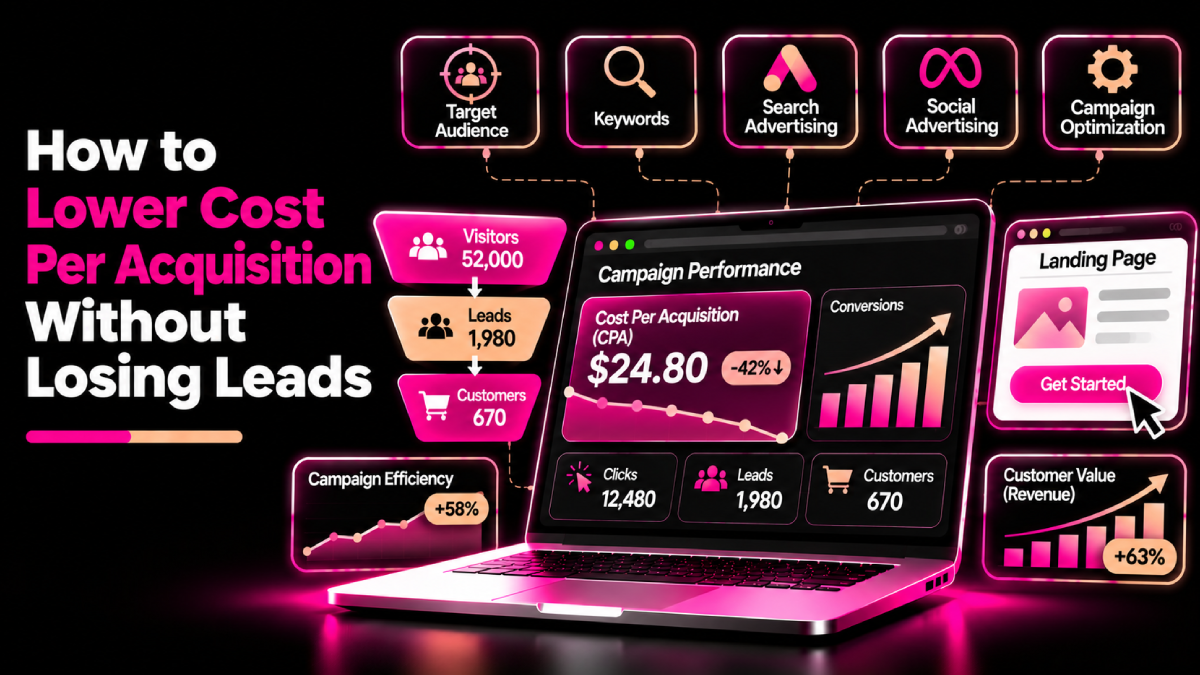
Getting more customers does not always require a bigger marketing budget. Sometimes, the better opportunity lies in improving how efficiently your business attracts and converts potential buyers. Understanding how to lower cost per acquisition helps you reduce unnecessary marketing spend while maintaining the quality and volume of leads.
Cost per acquisition (CPA) measures how much you spend to generate a specific conversion, such as a purchase, qualified enquiry, or booked consultation. A high CPA can reduce profitability, especially when advertising costs rise or conversion rates remain low.
The goal is not simply to spend less. It is to generate more valuable customers from your existing marketing investment. Here are practical ways to improve acquisition efficiency without sacrificing lead quality.
1. Understand Your Current Cost Per Acquisition
Before changing campaigns, establish how much your business currently spends to acquire a customer or generate a conversion.
Use this basic formula:
CPA = Total campaign cost ÷ Number of conversions
For example, if you spend $2,000 on a campaign and generate 40 conversions, your CPA is $50.
However, distinguish between platform-reported CPA and your overall customer acquisition cost. Platform CPA may include only advertising spend and tracked conversions. A broader acquisition calculation can include agency fees, marketing software, creative production, and other relevant costs.
Track these metrics together:
- Cost per click (CPC)
- Conversion rate
- Cost per lead
- Cost per qualified lead
- Lead-to-customer conversion rate
- Customer acquisition cost (CAC)
This helps you identify whether the problem comes from expensive traffic, poor conversion performance, or low-quality leads.
2. Improve Audience and Keyword Targeting
One of the most common reasons for high acquisition costs is attracting people who are unlikely to become customers.
Review your audience targeting and keyword selection before increasing your advertising budget.
For Google Ads campaigns:
- Focus on search terms that match your products or services.
- Review search term reports regularly.
- Add irrelevant queries as negative keywords.
- Separate campaigns by service, product, or search intent.
- Review geographic targeting and exclude areas you do not serve.
For social media campaigns, refine audiences using relevant interests, behaviours, and customer data where permitted. Test different audience segments instead of relying on one broad targeting setup.
For example, a B2B software company may generate many clicks from people researching free tools. By focusing on searches that indicate commercial intent, it can improve the relevance of incoming traffic.
The objective is to attract fewer unqualified visitors and more potential customers.
3. Improve Landing Page Conversion Rates
You can lower CPA without reducing advertising spend by converting a higher percentage of existing visitors.
Suppose a campaign receives 1,000 clicks and generates 20 leads. Its conversion rate is 2%. If landing page improvements increase conversions to 30 while traffic and spend remain unchanged, the cost per lead falls.
Start by reviewing your landing pages:
- Match the headline to the advertisement.
- Explain your main value proposition clearly.
- Place the primary CTA where visitors can find it.
- Remove unnecessary form fields.
- Add genuine reviews and relevant trust signals.
- Make the page easy to use on mobile devices.
- Improve loading speed and remove distracting elements.
Test one major change at a time. For example, compare a shorter enquiry form with your existing form and measure completed, qualified submissions.
Use Google PageSpeed Insights to identify performance issues and follow Google’s Core Web Vitals guidance.
4. Optimize Your Advertising Campaigns
Paid advertising can become expensive when businesses leave campaigns running without reviewing performance.
A regular optimization process helps identify where your budget produces results and where it gets wasted.
For Google Ads:
- Review campaign and keyword performance.
- Identify search terms that generate irrelevant clicks.
- Compare conversion rates across campaigns.
- Review bidding strategies against your acquisition targets.
- Test new ad headlines and descriptions.
- Reallocate budget based on conversion quality.
For Meta Ads, review creative performance, audience segments, placement results, and conversion data. Refresh advertisements when performance declines, but avoid making frequent changes without enough evidence.
Also, ensure your conversion tracking works correctly before relying on automated bidding. Google’s conversion tracking documentation explains how to measure valuable customer actions.
5. Use SEO to Reduce Dependence on Paid Acquisition
Paid advertising can provide visibility quickly, but every additional click can add to campaign costs. Organic search offers another way to attract people who are already looking for relevant products or services.
A consistent SEO strategy can build long-term acquisition opportunities through:
- Service pages targeting commercial search terms
- Helpful articles addressing customer questions
- Relevant internal links between content and service pages
- Technical improvements that support crawling and user experience
- Useful content that demonstrates subject knowledge
Start with keywords that reflect customer needs and buying intent. Then build pages that answer those needs clearly.
Follow Google’s SEO Starter Guide and explore SEOXREACH’s global content strategy services to understand how content can support organic visibility.
Remember that SEO also requires investment in content, technical work, and maintenance. It is not free acquisition, and results usually take time. However, organic visibility can diversify your customer acquisition channels.
6. Improve Lead Quality Instead of Chasing More Leads
A low cost per lead does not necessarily mean a low cost per customer.
For example, Campaign A may generate 100 leads at $10 each, while Campaign B generates 40 leads at $20 each.
If Campaign A converts 5% of its leads into customers, it produces five customers. If Campaign B converts 25%, it produces ten customers.
Campaign B has a higher cost per lead but a lower cost per customer.
To improve lead quality:
- Define what makes a lead qualified.
- Add relevant questions to enquiry forms.
- Target audiences that match your ideal customer profile.
- Use CRM data to track leads through the sales process.
- Share sales outcomes with your marketing team.
- Optimize campaigns for meaningful conversions where tracking allows.
This approach helps your business focus on customers who are more likely to generate revenue.
7. Increase Customer Retention and Repeat Purchases
Acquiring a new customer is only one part of sustainable growth. Existing customers can generate additional revenue through repeat purchases, renewals, upgrades, and referrals.
Improve retention with:
- Relevant email follow-ups
- Helpful onboarding experiences
- Personalized product recommendations
- Loyalty programs where appropriate
- Timely customer support
- Re-engagement campaigns
For example, an eCommerce business can send relevant product recommendations based on previous purchases. A service provider can follow up with customers when they may need another appointment or maintenance service.
Retention does not change the historical CPA of an earlier campaign. However, it can improve customer lifetime value and make the overall acquisition investment more profitable.
8. Track Performance and Test Improvements Regularly
Reducing acquisition costs requires consistent measurement rather than guesswork.
Build a monthly dashboard that tracks:
| Metric | Why it matters |
|---|---|
| Total marketing spend | Shows your acquisition investment |
| Cost per lead | Measures enquiry generation efficiency |
| Qualified lead rate | Shows lead relevance |
| Customer acquisition cost | Measures cost to acquire customers |
| Conversion rate | Identifies funnel performance |
| Customer lifetime value | Helps assess long-term customer value |
Compare results across channels and customer segments. If CPA increases, investigate changes in traffic quality, competition, landing page performance, conversion tracking, and sales follow-up.
Test improvements in a controlled way. Avoid changing targeting, creative, bidding, and landing pages simultaneously because it becomes harder to identify what caused the result.
Common Mistakes That Increase Acquisition Costs
Avoid these common problems:
- Targeting broad audiences without reviewing lead quality
- Sending all paid traffic to the homepage
- Ignoring negative keywords
- Optimizing for form submissions instead of qualified leads
- Making major campaign changes without enough data
- Neglecting website speed and mobile usability
- Ignoring customer retention and repeat revenue
- Comparing CPA across channels without considering conversion quality
A lower CPA is valuable only when the customers you acquire still support your business goals.
Conclusion
Lower acquisition costs come from improving the entire customer journey, not simply reducing advertising spend. Refine your targeting, strengthen landing pages, improve lead quality, invest in organic visibility, and measure the results that contribute to actual sales. By understanding how to lower cost per acquisition, your business can make more informed marketing decisions, improve campaign efficiency, and build a more profitable customer acquisition strategy.
FAQs About How to Lower Cost Per Acquisition Without Losing Leads
Quick answers related to this guide, and how SEOXREACH can help you apply them.
There is no universal ideal CPA. It depends on your product price, profit margin, customer lifetime value, sales conversion rate, and business model. Set a target based on what your business can afford to spend profitably.
Improve keyword targeting, add relevant negative keywords, refine ad copy, optimize landing pages, and verify conversion tracking. Review qualified customer outcomes before increasing budgets or changing bidding strategies.
Yes, when campaign spend remains stable and more visitors convert, the cost per conversion decreases. However, you should also monitor lead quality to ensure that additional conversions have real business value.
CPA measures the cost of generating a defined conversion, such as a lead or purchase. CAC measures the broader cost of acquiring a paying customer and may include additional sales and marketing expenses.
SEO can diversify customer acquisition by attracting relevant organic traffic without paying for every click. However, content creation, technical optimization, and ongoing SEO work still require investment.
Not automatically. Cutting spend may reduce total conversions without improving efficiency. First, identify wasted traffic, weak landing pages, and poor conversion quality. Then make budget decisions based on profitability and reliable campaign data.
Ready to Grow Organically?
Get a custom SEO strategy to increase your traffic, leads and revenue with SEOXREACH.
Get a Free SEO Audit →- More Traffic
- Higher Rankings
- Increase Revenue