
Tips for PPC Campaign Optimization that Improve ROI
November 11, 2026
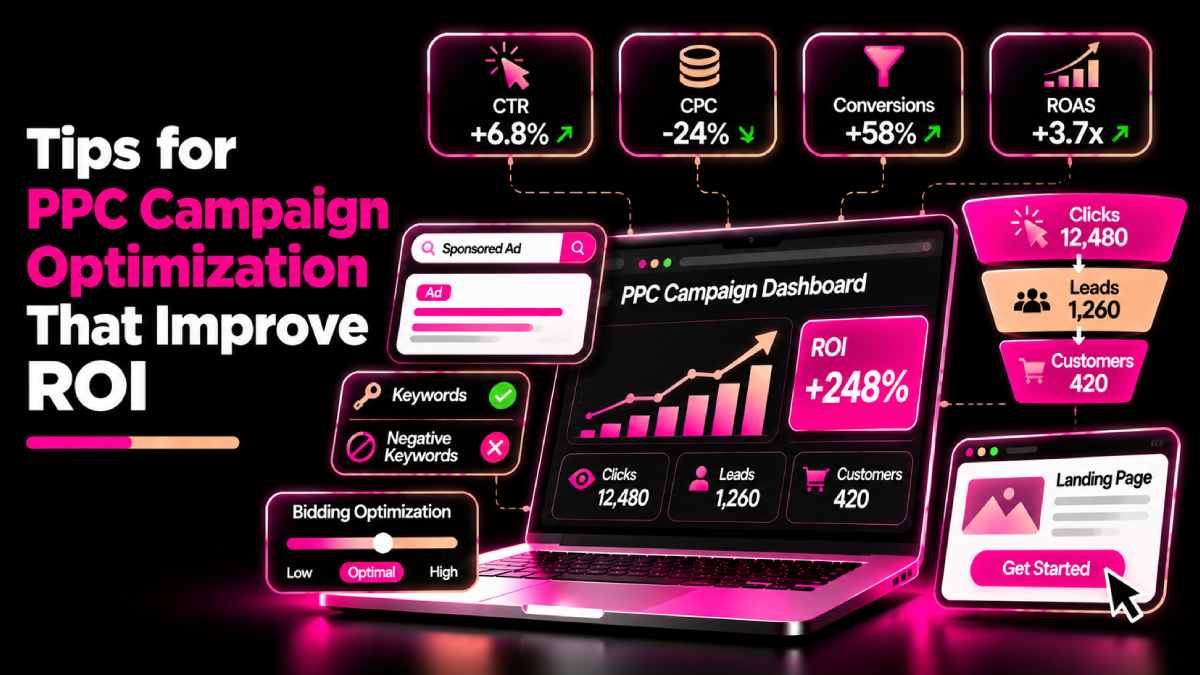
Running paid advertising campaigns can bring visitors to your website quickly. However, more clicks do not always mean more customers. If your ads attract the wrong audience, target irrelevant searches, or send visitors to weak landing pages, your budget can disappear without producing meaningful results.
Effective PPC campaign optimization focuses on improving every part of your advertising process, from keyword selection and ad messaging to conversion tracking and landing page performance.
Whether you manage Google Ads for a small business, SaaS company, or eCommerce brand, the following tips can help you reduce wasted spend, improve campaign efficiency, and generate better returns from your advertising investment.
1. Set Clear Campaign Goals and KPIs
Before changing bids or increasing your budget, define what you want each campaign to achieve.
Different campaign objectives require different optimization strategies. For example, an eCommerce business may prioritize purchases and revenue, while a B2B company may focus on qualified enquiries and booked sales calls.
Choose KPIs that connect advertising activity to business results:
- Click-through rate (CTR)
- Conversion rate
- Cost per conversion
- Cost per qualified lead
- Return on ad spend (ROAS)
- Customer acquisition cost (CAC)
Avoid judging campaign success by impressions and clicks alone. A campaign that generates fewer clicks but more qualified customers may deliver better business value.
2. Research and Refine Your PPC Keywords
Keyword selection directly affects which searches trigger your ads. Broad or poorly researched keywords can attract visitors who have little interest in your offer.
Start by grouping keywords according to search intent:
- Transactional: “buy running shoes online”
- Commercial: “best accounting software for small business”
- Service-focused: “PPC management agency”
- Informational: “how does PPC advertising work”
Prioritize keywords that match your products, services, and conversion goals.
Next, review your search terms report in Google Ads. It shows the searches that triggered your ads and helps you identify irrelevant traffic.
Add suitable negative keywords to prevent ads from appearing for searches that do not match your offer. For example, a paid software campaign may exclude terms such as “free download” if those searches do not match its business model.
Review keyword match types and search terms regularly rather than assuming your original keyword list will remain effective.
3. Write Relevant and Compelling Ad Copy
Your ad copy should make it clear why someone should choose your business.
A strong advertisement connects the searcher’s need with a relevant solution. It should also set accurate expectations about what visitors will find after clicking.
Improve your ads by:
- Including the main product, service, or benefit.
- Matching the message to the keyword and search intent.
- Highlighting genuine differentiators.
- Using a clear call to action.
- Adding relevant assets, such as sitelinks and callouts.
- Testing different headlines and descriptions.
For example, a generic headline such as “Professional Marketing Services” may be less specific than “PPC Management for Growing Businesses.”
Use Google’s responsive search ads guidance to understand how to create and improve search ad variations.
Do not make unsupported claims or promise results that your business cannot deliver.
4. Optimize Bidding and Budget Allocation
Your bidding strategy influences how Google Ads competes for available advertising opportunities. However, the right approach depends on your campaign goals, conversion data, competition, and budget.
Review your bidding strategy against actual performance.
Consider these practices:
- Set a realistic daily budget based on your business objectives.
- Check whether campaigns receive enough budget to gather useful performance data.
- Review cost per conversion and conversion value.
- Avoid frequent bid changes without enough evidence.
- Allocate more budget to campaigns that produce valuable results.
Automated bidding can help optimize bids toward selected goals, but it still depends on accurate tracking and suitable campaign settings.
For example, a campaign using a target cost per acquisition should have a realistic target based on historical performance and acceptable customer acquisition costs.
Read Google’s Smart Bidding documentation before selecting or changing an automated bidding strategy.
5. Improve Landing Page Experience
A relevant ad can still underperform if the landing page does not meet the visitor’s expectations.
When someone clicks your advertisement, the destination page should continue the same message and make the next action clear.
Review these elements:
- Message consistency: Match the landing page headline to the ad promise.
- Clear value proposition: Explain what makes your offer useful.
- Visible CTA: Make the next step easy to understand.
- Simple forms: Request only essential information.
- Trust signals: Include genuine reviews, testimonials, and relevant credentials.
- Mobile usability: Make buttons, text, and forms easy to use on smaller screens.
- Page speed: Reduce unnecessary scripts and oversized media.
Use Google PageSpeed Insights to identify performance issues.
If your ad promotes a specific service, send visitors to that service’s landing page instead of a generic homepage. A closer match between the ad and destination can improve the visitor experience and conversion potential.
6. Set Up Accurate Conversion Tracking
Conversion tracking helps you understand which campaigns, keywords, and advertisements generate valuable actions.
Without reliable tracking, you may optimize for clicks while overlooking the activity that contributes to sales.
Depending on your business, track actions such as:
- Completed purchases
- Qualified lead form submissions
- Phone calls that meet your criteria
- Booked consultations
- Trial registrations
- Important subscription events
Set up conversion actions using Google Ads conversion tracking.
Test your tracking setup before making major campaign decisions. Check for duplicate events, missing conversions, and actions that do not represent genuine business value.
For lead generation, connect advertising data with your CRM where possible. This helps you distinguish between a form submission and a lead that becomes a paying customer.
7. Use Negative Keywords and Exclude Irrelevant Traffic
Negative keywords help prevent your ads from appearing for searches that do not fit your campaign.
Review search terms frequently, especially after launching a new campaign or expanding keyword coverage.
For example, a premium web design agency might exclude searches containing terms such as “free template” or “DIY website builder” if those users are unlikely to need its services.
You can also review location, device, audience, and placement performance where relevant to your campaign type.
Make exclusions carefully. A search term that looks irrelevant at first may still contribute to valuable conversions, so review context and performance before blocking it.
8. Test Campaign Changes and Review Performance Regularly
PPC optimization is an ongoing process. Audience behaviour, competition, search demand, and advertising costs can change over time.
Create a regular review routine:
| Review area | What to check |
|---|---|
| Search terms | Irrelevant queries and new keyword opportunities |
| Ad copy | CTR, relevance, and conversion performance |
| Landing pages | Conversion rate and user experience |
| Bidding | Cost per conversion and campaign goals |
| Budget | Spend distribution and campaign efficiency |
| Conversions | Tracking accuracy and lead quality |
Test meaningful changes rather than changing several campaign elements simultaneously. This makes it easier to understand which adjustment influenced performance.
For example, test a new landing page headline while keeping the main campaign settings stable. Compare the results over a suitable period and account for conversion volume before deciding whether the change helped.
Common PPC Optimization Mistakes to Avoid
Even well-planned campaigns can waste budget when businesses overlook important details.
Avoid these common mistakes:
- Optimizing for clicks instead of business outcomes.
- Using broad keywords without reviewing search terms.
- Increasing budgets before checking conversion quality.
- Sending every advertisement to the same landing page.
- Ignoring mobile visitors.
- Making frequent changes without enough performance data.
- Trusting automated bidding when conversion tracking is inaccurate.
- Failing to review actual sales or lead quality.
A structured optimization process helps you identify problems before they become expensive.
Conclusion
Successful paid advertising requires more than launching campaigns and waiting for clicks. Businesses need relevant keywords, persuasive ads, accurate conversion tracking, effective landing pages, and regular performance reviews. Start with clear goals, identify where your budget is being wasted, and test improvements using reliable data. Consistent PPC campaign optimization can help your business make better advertising decisions, improve campaign efficiency, and generate more value from its paid media investment.
FAQs About Tips for PPC Campaign Optimization that Improve ROI
Quick answers related to this guide, and how SEOXREACH can help you apply them.
PPC campaign optimization is the process of improving paid advertising performance by refining keywords, ads, bidding, budgets, targeting, landing pages, and conversion tracking.
Review important performance metrics regularly. Many businesses check search terms and spending weekly, then conduct a deeper performance review monthly. The right frequency depends on campaign size, activity, and conversion volume.
Review search terms, add relevant negative keywords, improve audience and location targeting, and send visitors to relevant landing pages. Also, check conversion tracking so you can identify which traffic produces genuine business value.
There is no universal conversion rate that applies to every industry. Performance depends on the offer, audience, keyword intent, pricing, competition, and landing page. Compare results with your own historical performance and business targets.
PPC management covers the broader process of planning, launching, monitoring, and maintaining paid campaigns. PPC optimization focuses on making specific improvements to increase efficiency and achieve campaign goals.
Compare the financial return attributed to advertising with the campaign cost. For a more accurate profitability assessment, account for product costs, service delivery, agency fees, and other relevant expenses. For eCommerce campaigns, ROAS is useful, but it does not automatically represent profit.
Ready to Grow Organically?
Get a custom SEO strategy to increase your traffic, leads and revenue with SEOXREACH.
Get a Free SEO Audit →- More Traffic
- Higher Rankings
- Increase Revenue