
ROI-Driven Digital Marketing Tactics For Your Business
November 9, 2026
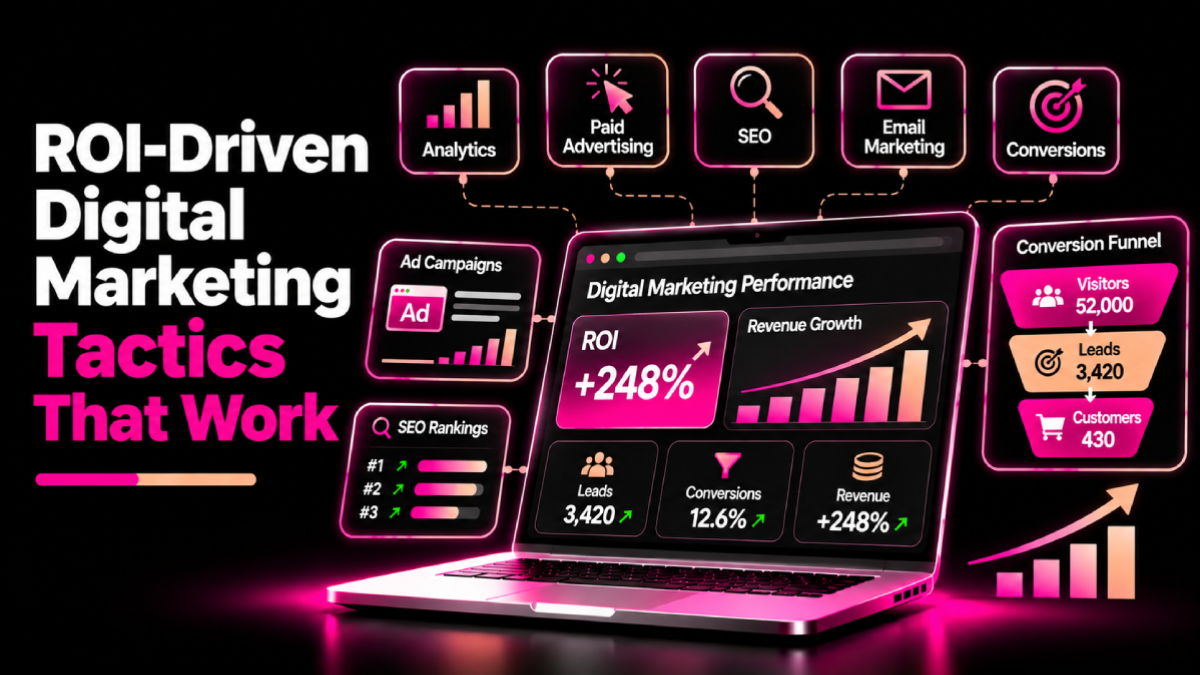
Digital marketing can generate traffic, clicks, and social engagement without producing meaningful business growth. The difference comes down to how well your campaigns turn marketing investment into measurable results. ROI-driven digital marketing tactics help businesses focus on revenue, qualified leads, customer retention, and the cost of acquiring each customer not just visibility.
However, improving marketing ROI does not always mean spending less. It means investing in the right channels, reaching the right audience, and improving the steps between a first interaction and a sale.
Whether you run a small business, an eCommerce store, or a growing B2B company, the following tactics can help you make better marketing decisions and build campaigns around business outcomes.
1. Set Clear Marketing Goals Before Spending
A campaign cannot deliver measurable ROI if you have not defined what success looks like. Therefore, begin with a specific business objective rather than choosing a channel simply because competitors use it.
Your goals might include:
- Generating qualified sales enquiries
- Increasing online purchases
- Reducing customer acquisition cost
- Improving repeat purchases
- Growing revenue from existing customers
Next, connect each goal to a measurable KPI. For example, a lead generation campaign should track qualified leads and cost per qualified lead, not just form submissions.
Set a baseline using previous campaign results. This gives you a fair way to compare performance after making changes.
2. Invest in SEO to Build Long-Term Acquisition Value
Search engine optimization can support sustainable customer acquisition by helping your website reach people who are actively looking for your products or services.
Unlike paid advertising, organic search does not charge you for every click. However, SEO still requires investment in content, technical improvements, and ongoing optimization. Results also take time.
To make SEO more commercially effective:
- Research keywords that indicate a real need or buying intent.
- Create useful landing pages that answer the searcher’s specific question.
- Improve page structure, internal links, and website navigation.
- Make important pages fast, mobile-friendly, and easy to use.
- Track organic leads and sales in addition to search rankings.
For a stronger foundation, review Google’s SEO Starter Guide and explore how SEO services can connect content planning with business goals.
The key is to measure the value of organic traffic, not simply the volume.
3. Use Paid Advertising With Strict Conversion Tracking
Paid advertising can help businesses reach potential customers quickly. However, clicks alone do not prove that a campaign is profitable.
Platforms such as Google Ads and Meta Ads offer different ways to reach audiences. Google Ads can capture existing search demand, while Meta Ads can introduce products and services to relevant audiences.
Before increasing your budget:
- Install and test conversion tracking.
- Track calls, purchases, qualified forms, and other meaningful actions.
- Separate campaigns by audience, service, or product.
- Review search terms and exclude irrelevant traffic where appropriate.
- Compare campaign performance against your profit margins.
For example, a campaign that generates many low-quality enquiries may perform worse than one that produces fewer but more valuable leads.
Start with a controlled budget, evaluate conversion quality, and scale only when the results support it.
4. Improve Conversion Rates Before Buying More Traffic
More traffic does not automatically mean more revenue. If visitors cannot understand your offer or complete the next step, additional advertising may only increase costs.
Conversion rate optimization (CRO) focuses on removing barriers that stop visitors from taking action.
Start by reviewing your most important landing pages. Check whether they have:
- A clear headline that matches the visitor’s intent
- A specific explanation of the service or product
- Visible calls to action
- Trust signals, such as genuine reviews and relevant credentials
- Simple forms with only necessary fields
- Mobile-friendly layouts and fast loading times
Then test one significant change at a time. You could compare two headlines, CTA placements, or form layouts. Measure completed conversions rather than relying on opinions about which design looks better.
Use Google PageSpeed Insights to identify performance issues and review Google’s Core Web Vitals guidance for technical experience improvements.
5. Build Content Around Customer Buying Intent
Content marketing becomes more valuable when each piece supports a stage of the customer journey.
A person researching a problem needs different information from someone comparing providers or preparing to buy. Therefore, build content for three broad stages:
- Awareness: Educational guides, explainers, and problem-focused articles.
- Consideration: Comparisons, service breakdowns, case studies, and practical examples.
- Decision: Pricing information, product details, testimonials, and clear enquiry options.
Connect relevant articles to service pages using descriptive internal links. This helps readers find the next useful step while giving search engines context about your website.
Avoid publishing articles just to increase content volume. Follow Google’s people-first content guidance and make every page useful to its intended audience.
6. Use Email Marketing to Increase Customer Lifetime Value
Acquiring a new customer often requires more effort than encouraging an existing customer to return. Email marketing can help businesses build stronger relationships and generate repeat revenue.
Instead of sending the same message to everyone, segment your audience based on their behaviour and interests.
Useful email campaigns include:
- Welcome emails for new subscribers
- Follow-ups for people who requested a quote
- Abandoned-cart reminders for eCommerce stores
- Product recommendations based on previous purchases
- Re-engagement emails for inactive customers
Keep messages relevant and provide a clear next step. Track clicks, conversions, revenue, unsubscribes, and the performance of each campaign.
Email should support the customer relationship, not overwhelm the inbox.
7. Use Analytics to Identify What Actually Drives Revenue
Marketing decisions become more reliable when you connect campaign activity with business outcomes.
Use tools such as Google Analytics and Google Search Console to understand how visitors discover and interact with your website.
Build a simple reporting dashboard that tracks:
- Marketing spend by channel
- Leads and purchases generated
- Cost per lead or acquisition
- Lead-to-customer conversion rate
- Revenue attributed to campaigns
- Customer retention and repeat purchases
Review performance regularly. If a channel generates traffic but few qualified conversions, investigate the audience, landing page, offer, and tracking setup before increasing spend.
Also, use consistent attribution rules. A customer may interact with several channels before purchasing, so last-click reporting alone may not explain the full customer journey.
8. Calculate ROI and Allocate Budget Based on Evidence
A basic marketing ROI calculation helps you compare investment with the return it generates.
Marketing ROI formula:
Marketing ROI = (Revenue attributed to marketing − Marketing cost) ÷ Marketing cost × 100
For example, if a campaign generates $12,000 in attributed revenue and costs $3,000, the calculation is:
($12,000 − $3,000) ÷ $3,000 × 100 = 300%
This is a simplified revenue-based calculation. It does not account for product costs, fulfilment, salaries, or other operating expenses. For a clearer picture of profitability, compare contribution margin with the full cost of marketing and acquisition.
Use the results to guide your next decisions:
- Identify channels that generate valuable customers.
- Check whether results remain consistent over time.
- Reduce spend on campaigns that fail to meet your business targets.
- Test improvements before making large budget changes.
- Reinvest in channels that show sustainable, profitable performance.
Do not judge every channel by the same short-term target. SEO, paid search, email, and social advertising can contribute at different stages of the buying journey.
Common Mistakes That Reduce Digital Marketing ROI
Even well-funded campaigns can underperform when businesses overlook basic execution.
Watch out for these mistakes:
- Measuring impressions and clicks without tracking conversions
- Targeting broad audiences without a clear customer profile
- Sending paid traffic to generic or irrelevant landing pages
- Ignoring mobile usability and website performance
- Failing to follow up with leads quickly
- Scaling campaigns before confirming lead quality
- Treating attributed revenue as guaranteed incremental revenue
A consistent measurement process helps you spot these issues before they consume more budget.
Conclusion
Successful marketing is not about being present on every platform or spending more than competitors. It is about understanding what customers need, choosing channels that support your business goals, and measuring the outcomes that matter. Start with clear targets, improve conversion paths, and use reliable data to guide your investment. By applying ROI-driven digital marketing tactics consistently, your business can make smarter marketing decisions and build a more sustainable path to growth.
FAQs About ROI-Driven Digital Marketing Tactics For Your Business
Quick answers related to this guide, and how SEOXREACH can help you apply them.
They are marketing methods designed to generate measurable business outcomes, such as qualified leads, sales, repeat purchases, and profitable customer acquisition. They focus on results rather than activity alone.
There is no single channel that works best for every business. SEO can build long-term organic visibility, paid advertising can capture demand quickly, and email can support retention. The right mix depends on your audience, margins, sales cycle, and goals.
Compare the revenue attributed to marketing with the cost of the campaign. For a more complete profitability assessment, include product or service delivery costs, agency fees, software, and other relevant expenses.
Start by defining one clear conversion goal, tracking it properly, improving your website's landing pages, and focusing on channels that reach likely customers. Review results before increasing your budget.
It depends on the channel and starting point. Paid campaigns may generate early traffic, while SEO and content marketing generally require sustained work. Conversion improvements can show results sooner when a website already receives relevant traffic.
Choose the metric that reflects your business model, but connect lead generation to actual sales wherever possible. A high number of enquiries has limited value if those enquiries rarely become customers.
Ready to Grow Organically?
Get a custom SEO strategy to increase your traffic, leads and revenue with SEOXREACH.
Get a Free SEO Audit →- More Traffic
- Higher Rankings
- Increase Revenue